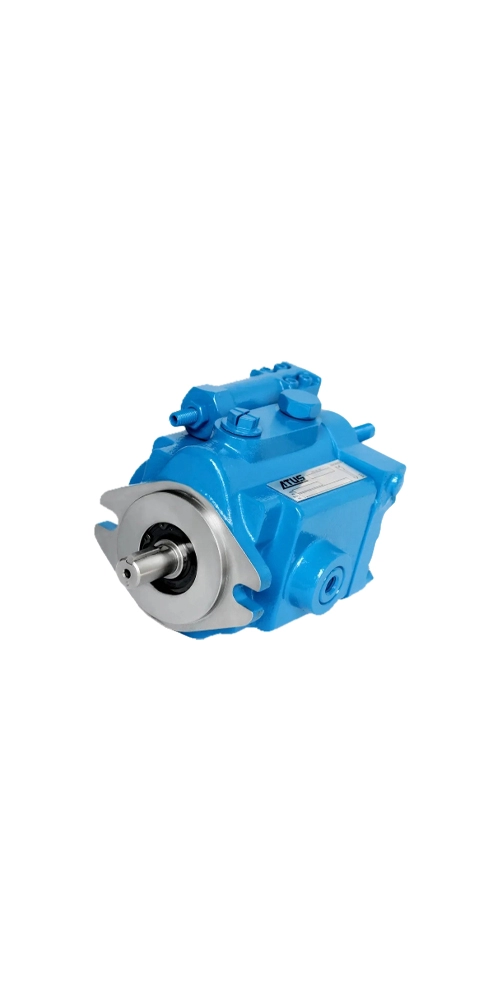
ATUS-Axial Piston Variable Pumps-APV-D-PV-500×1000

APV-D-PV-100

APV-D-PV Series Axial Piston Variable Pumps
Size NG
47
Displacement
100 cm³/rev
Speed
1800 rpm
Flow
180 L/min
Nominal pressure
280 bar
Max. Pressure
300 bar
Weight (approx.)
71 kg

Products and performance

The APV-D-PV-100 variable axial piston pump, with an NG47 mounting size, has a displacement of 100 cm³/rev and can stably output a flow rate of 180 L/min at a rated speed of 1800 rpm. Its rated pressure is 280 bar, with a maximum pressure of up to 300 bar, making it ideal for harsh, heavy-duty operating conditions.
This pump utilizes mature variable displacement technology, automatically adjusting the displacement according to real-time load requirements, effectively reducing energy consumption and hydraulic oil loss while maintaining stable hydraulic system operation, significantly improving overall work efficiency. An advanced control system enables precise hydraulic regulation, optimizing the positioning accuracy and operational stability of the host equipment.
This pump boasts high reliability and wide applicability, maintaining stable performance even in harsh industrial environments. It is widely used in critical equipment in the metallurgical industry, injection molding machines, mining equipment, and construction machinery. The APV-D-PV-100 provides energy-saving, efficient, and long-term reliable hydraulic power, making it an ideal core power component for high-pressure, heavy-duty industrial hydraulic systems.

Energy‑Saving Performance

Automatic displacement adjustment reduces energy and hydraulic oil waste while keeping the whole hydraulic system stable in operation.
High Working Efficiency

Optimized power output lowers internal losses and effectively improves the comprehensive efficiency of the complete hydraulic equipment.

Precise Control

Sophisticated variable displacement technology achieves accurate hydraulic control and enhances equipment accuracy and operational stability.

High Adaptability

The pump series maintains consistent and stable working performance under various complex and harsh on‑site operating conditions.

Outstanding Reliability

Delivers stable and trustworthy hydraulic power supply for long‑time continuous operation in heavy‑duty working scenarios.

Specifications

The standardized NG47 mounting dimension supports simple installation, good interchangeability and convenient integration into main equipment.
Standard displacement of 100 cm³/rev ensures stable output flow and uniform, controllable movement of hydraulic actuators.
Supports a rated speed of 1800 rpm, ensuring smooth operation at high speeds and fully matching the power output requirements of the host machine.
Rated output flow of 180 L/min provides ample and efficient oil supply to meet the rapid cyclic operation conditions of the equipment.
Standard rated working pressure of 280 bar, reliable pressure resistance under continuous heavy loads, and excellent long-term operational stability.
Maximum pressure up to 300 bar, strong resistance to short-term impact loads, and capable of meeting the peak pressure requirements of the equipment.
The optimized total weight of 71 kg balances structural rigidity and portability, making it easy to install on mining machinery.
Widely compatible with metallurgy, injection molding, mining, and construction machinery, ensuring stable and long-term operation under harsh, heavy-duty conditions.
The ATUS-D-PV series hydraulic pumps are axial piston variable displacement hydraulic pumps with pressure compensation (constant pressure) as their basic control function. They meet the requirements of low noise and high efficiency, are properly designed and robustly constructed, and can provide reliable hydraulic power even under harsh conditions.
Using this series of hydraulic pumps can easily improve the operating efficiency of your machines, upgrade their performance, and reduce maintenance workload. Because this series of hydraulic pumps has good interchangeability with other commonly used hydraulic pumps, you can use this series of pumps to replace existing hydraulic pumps whose performance does not meet your needs.
Low noise - Low noise level throughout the entire operating range, improving working conditions;
Contamination resistant - Improved operational reliability and reduced maintenance costs;
High power - High rated operating pressure, resulting in high output power. Except for the ATUS-PV29, which has a maximum instantaneous working pressure of 4000 psi (276 bar), all other models have a maximum instantaneous working pressure of 4500 psi (310 bar);
Cost-saving system – Higher working pressure allows for smaller components, reducing overall system size and resulting in real cost savings;
Multi-pump tandem operation – This series of hydraulic pumps features full-power through-shaft operation, enabling multiple pumps to be driven from the same prime mover shaft;
Ease of use – Side and tail port configurations are available for easy installation and use;
High efficiency – Extremely high overall efficiency;
High safety – Can use fire-resistant hydraulic fluids;
Simple structure – Improved reliability and long service life;
Flow regulation – The maximum output flow rate of the pump can be adjusted using the standard maximum displacement adjustment device to meet your needs;
Interchangeability – Mounting dimensions fully comply with SAE flange mounting standards, and port connections comply with BSPP or SAE-61 four-hole flange standards, compatible with any other SAE-compliant flanges. Interchange with standard plunger pumps.
Maximum displacement adjustment;
Fast pressure compensation (constant pressure) variable mechanism; Response time: 50 ms when displacement decreases; 120 ms when displacement increases; Other optional variable control modes include: pressure compensation (constant pressure) variable control with remote control, load-sensing variable control, and torque-limited (constant power) variable control.
Distributor plate—replaceable;
Smooth power output and quiet operation—the effect of the nine-plunger rotor assembly;
Adjustable pressure compensation controller;
Flat key and spline shaft extension—compliant with industry standards;
SAE standard mounting configuration—easily interchangeable with other products compliant with SAE mounting standards;
Low oil Level Inclination Angle-Front Up
45 °
Low oil Level Inclination Angle-Back Up
45 °
Low oil Level Inclination Angle-Fuel Pump Side Up
45 °
Low oil Level Inclination Angle-Exhaust Side Up
45 °
Oil Sump Capacity-Upper Limit
14.2 L
Oil Sump Capacity-Lower Limit
12.4 L
Capacity of The Whole System
16.4 L
- The factory assembly clearance between piston ball head and slipper ball socket is normally 0.015~0.025 mm.
- After prolonged service, the clearance enlarges. Parts can still be used if the clearance does not exceed 0.3 mm.
- Overlarge clearance will cause increased pulsation of pump outlet pressure and flow.
- In serious cases, loose slippers and slipper detachment may happen, further resulting in severe pump damage.
- Once signs of pressure and flow pulsation are detected, inspect slipper looseness in advance and conduct slipper re-clinching promptly.
- After long-term operation, concave deformation will form on the flat surface of the swash plate.
- The workpiece can be surface-ground followed by nitriding treatment.
- If the removed material thickness (e.g. 0.2 mm) does not completely eliminate the original nitrided layer, re-nitriding may be omitted.
- Hardness inspection of the swash plate surface is mandatory in such cases.
- Excessive bearing internal clearance will break the normal clearance of friction pairs and damage the oil film thickness of hydrostatic support, shortening the service life of piston pumps.
- The average service life of general bearings reaches 1000 hours (roughly more than two years). Bearings shall be replaced as appropriate after exceeding this service period.
- Replace with bearings of the identical model marked on the removed old bearing, or verified interchangeable alternatives.
- If grooves are scratched on the swash plate surface by piston ball heads (applicable to radial piston pumps), laser cladding with alloy powder is recommended for repair.
- Laser cladding ensures high bonding strength and hardness of deposited material without reducing the hardness of surrounding base metal.
- Manual overlay welding with chromium-type welding electrodes is an alternative method. The repaired swash plate surface requires re-heat treatment, preferably in a nitriding furnace.
- Regardless of the repair method adopted, the original dimensional accuracy, hardness and surface roughness of the swash plate must be restored.
Low oil Level Inclination Angle-Front Up
45 °
Low oil Level Inclination Angle-Back Up
45 °
Low oil Level Inclination Angle-Fuel Pump Side Up
45 °
Low oil Level Inclination Angle-Exhaust Side Up
45 °
Oil Sump Capacity-Upper Limit
14.2 L
Oil Sump Capacity-Lower Limit
12.4 L
Capacity of The Whole System
16.4 L
Main Causes and Troubleshooting Methods for Hydraulic Pump No Oil Suction / No Oil Discharge
  • Damage to the hydraulic pump, pump motor, or coupling between motor and pump. Replace the faulty pump, motor or coupling in a timely manner.
  • Too low oil level in the tank or excessively high pump installation position causes suction failure. Refill oil to the gauge level or adjust the pump height to keep the suction lift within the specified range.
  • Oil impurities and increased viscosity block the suction filter and oil pipe. Clean pipes and filters regularly and replace with qualified hydraulic oil as required.
  • Oil impurities and increased viscosity block the suction filter and oil pipe. Clean pipes and filters regularly and replace with qualified hydraulic oil as required.
Main causes and troubleshooting methods for hydraulic pumps discharging oil but lacking pressure and exhibiting reduced efficiency.
  • Severe wear of internal sliding parts leads to low volumetric efficiency and excessive axial/radial clearance. Replace the hydraulic pump or perform complete overhaul.
  • Damaged oil pipes and poor suction-side sealing cause air intake. Check all connections, reseal joints or replace damaged pipelines.
  • Blocked oil pipes and heavily contaminated filters. Clean pipelines and filters thoroughly to ensure full flow cleanliness.
  • Incorrect variable pump adjustment and severely worn relief valve spool. Readjust flow parameters and replace worn relief valve components for stable pump operation.
  • Motor speed below rated value and internal foreign impurities. Match the correct motor per specifications and clean internal impurities timely.
Major Causes of Excessive Noise During Hydraulic Pump Operation and Methods for Troubleshooting
  • Mostly caused by clogged filter, low oil level, air inhalation via oil seal and pipelines. Check tank oil level, repair pipelines, inspect pump seals, clean pipes and filters, and replace hydraulic oil periodically.
  • Excessively high oil viscosity, low oil temperature and entrained air bubbles. Select suitable hydraulic oil according to seasons.
  • Damaged coupling or misalignment between pump and motor leads to heavy vibration and loud noise. Inspect coupling wear, replace coupling and complete alignment strictly as installation requirements.
  • Operating speed exceeds rated value and mismatched driving motor. Reduce pump speed and select a suitable motor.
  • Worn shaft seal causes air intake; loose pump end cover bolts. Replace pump shaft seal and tighten cover bolts.
  • Low gear precision, poor contact or damaged internal parts of gear pump. Replace or grind gears, renew damaged components.
  • Insufficient axial clearance, out-of-tolerance perpendicularity or parallelism. Replace the gear pump entirely.
  • Blockage inside relief valve. Clean or replace the relief valve.
  • Vibration generated by unfixed pipelines. Secure all hydraulic pipelines firmly.
Main Causes of Oil Leakage from Hydraulic Pump Bodies and Methods for Rectification
  • Failure of the piston pump central spring breaks sealing between cylinder block and valve plate. Replace the spring and re-seal the mating surface.
  • Damaged oil seals or worn/poorly fitted gaskets at pipeline connections. Replace all defective sealing parts.
  • Severe wear of internal pump parts resulting in oversized operating clearances. Replace or refit the relevant components.
Main Causes of Hydraulic Pump Overheating and Troubleshooting Methods
  • Excessively high or low oil viscosity, and accumulated impurities after long service. Replace hydraulic oil in a timely manner and adopt oil with proper viscosity.
  • Heavy wear between pump side plates, shaft sleeves and gear end faces leads to overheating. Replace side plates, shaft sleeves or install a new hydraulic pump.
  • Small tank volume restricts heat dissipation and triggers high oil temperature. Increase tank capacity and expand heat dissipation area.
Installation Drawing
Download
Installation Manual
Download
Operation Manual
Download
Parts Catalogue
Download
Report & Certifcate
Download

Other Models

130cm³/rev
Speed
1800 rpm
Flow
234 L/min
Weight (approx.)
95 kg
Nominal pressure
280 bar
100cm³/rev
Speed
1800 rpm
Flow
180 L/min
Weight (approx.)
71 kg
Nominal pressure
280 bar
80cm³/rev
Speed
1800 rpm
Flow
144 L/min
Weight (approx.)
50 kg
Nominal pressure
280 bar
61.9cm³/rev
Speed
2400 rpm
Flow
148.56 L/min
Weight (approx.)
42 kg
Nominal pressure
207 bar
42.9cm³/rev
Speed
2400 rpm
Flow
102.96 L/min
Weight (approx.)
32 kg
Nominal pressure
240 bar
34.2cm³/rev
Speed
2500 rpm
Flow
85.5 L/min
Weight (approx.)
25 kg
Nominal pressure
240 bar
20.6cm³/rev
Speed
3000 rpm
Flow
61.8 L/min
Weight (approx.)
20 kg
Nominal pressure
240 bar
14.4cm³/rev
Speed
3000 rpm
Flow
43.2 L/min
Weight (approx.)
14 kg
Nominal pressure
240 bar

FREQUENTLY ASKED QUESTIONS

Get quick answers about this engine

With full ranges of emission standard from Euro 2 to Euro 7, Dongfeng Cummins producing 12 series automotive engines, started from 3.9 liter engine, to 15 liter engine, covering the power range of 125HP to 650HP.
Dongfeng Cummins automotive engine customize developing configurations for big vehicle OEMs in China, based on each of requirement, Dongfeng Cummins producing dozens of different configuration engines with same engine model number, which only SO-Shop Order will be different with each other, the SO number is the identify number of the engine configuration of each model.
Even with same engine model, different SO number engine can have very different configuration with each other, with different prices. Some of SO-Shop Order is not available for commercial market, such as restricted models (Usually for military specifications).
EMAC offering most common, cost effective models which also able to process the production in Dongfeng Cummins, which usually have following accessories as standard configuration.

Power OutPut
180 HP(132kW)
Max Torque
610 Nm
Displacement
5.9L
6 Inline
5.9L
Fuel System
Bosch Mechancial Pump
Emission Standard
Euro II

Lorem Ipsum is simply dummy text of the printing and typesetting industry. Lorem Ipsum has been the industry’s

Lorem Ipsum is simply dummy text of the printing and typesetting industry. Lorem Ipsum has been the industry’s

Lorem Ipsum is simply dummy text of the printing and typesetting industry. Lorem Ipsum has been the industry’s

Contact Us Now !!!

We are ready to provide professional support

Sales Director

Mr.Jasper Lee
Chat On whatsApp

Sales Manager

Mrs.Wendy Fu
Chat On whatsApp

Spare Parts Sales

Miss. Nora Cao
Chat On whatsApp

After-sales Manager

Mr. Jason Zhang
Chat On whatsApp

Merchandiser

Miss. yoyo tao
Chat On whatsApp
SEND US A MESSAGE

Google reCaptcha: Invalid site key.

CONTACT INFORMATION
Traveling Guidence

phone

Tel: +86-755-8231-4520

Hours

Monday-Friday: 9am – 7pm | Saturday-Sunday: Closed

Headquarters

23RD FLOOR, LINSN TOWER, GUANGMING, SHENZHEN, CHINA. 518107

FIND US
Headquarters
23RD FLOOR, LINSN TOWER, GUANGMING, SHENZHEN, CHINA. 518107
Input error
cancel